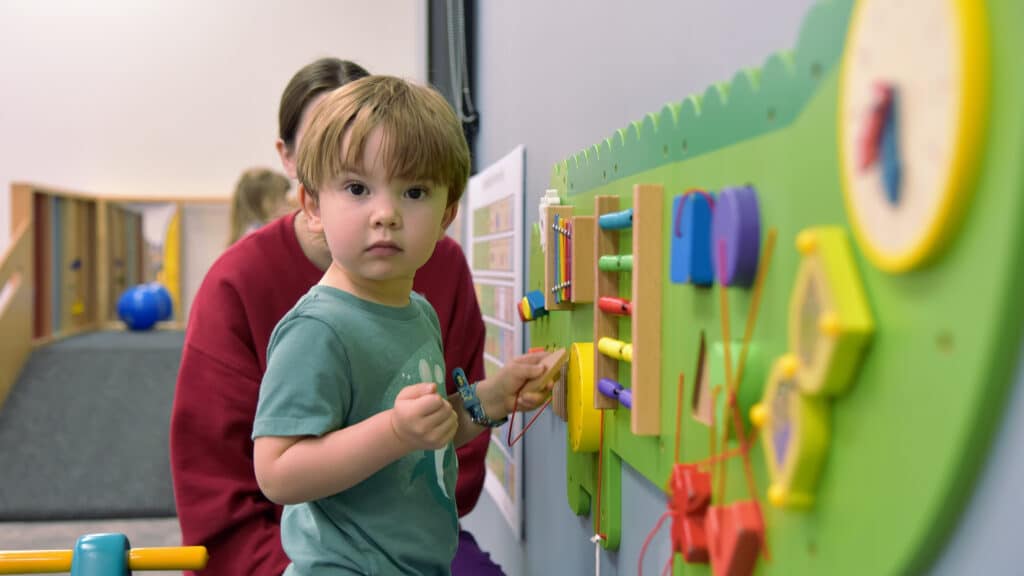
Activity wall panels are often easy for children to notice. They are colorful, hands-on, and placed at a child’s level. Children can walk up, reach out, and begin exploring.
That kind of immediate interest matters in pediatric therapy. When a child is curious about an activity, there are more opportunities to practice, repeat, communicate, problem-solve, and stay engaged.
An activity wall panel may include mazes, gears, beads, mirrors, sounds, textures, magnetic pieces, or other moving parts. Children can slide, spin, trace, push, turn, listen, match, and test how different pieces work.
These activities can support several areas of development. Moving small pieces can help with fine motor control. Following a maze can support hand-eye coordination and visual tracking. Turning gears can help children explore cause and effect. Staying with an activity can support attention, persistence, and problem-solving.
Activity panels can also support communication. A child may point to a favorite part, request “more,” ask for help, label an action, follow a direction, take turns, or share attention with a therapist, caregiver, or peer.
Depending on the child and the therapy goals, an activity wall panel may be used in Early Intervention, speech-language therapy, behavioral therapy, or occupational therapy. For one child, the focus may be reaching and exploring. For another, it may be using words or gestures. For another, it may be waiting, taking turns, following directions, or practicing fine motor control.
The panel is fun because children get to explore it with their hands, eyes, ears, and curiosity. In therapy, that interest gives providers a natural way to help children practice skills they can use in daily routines.